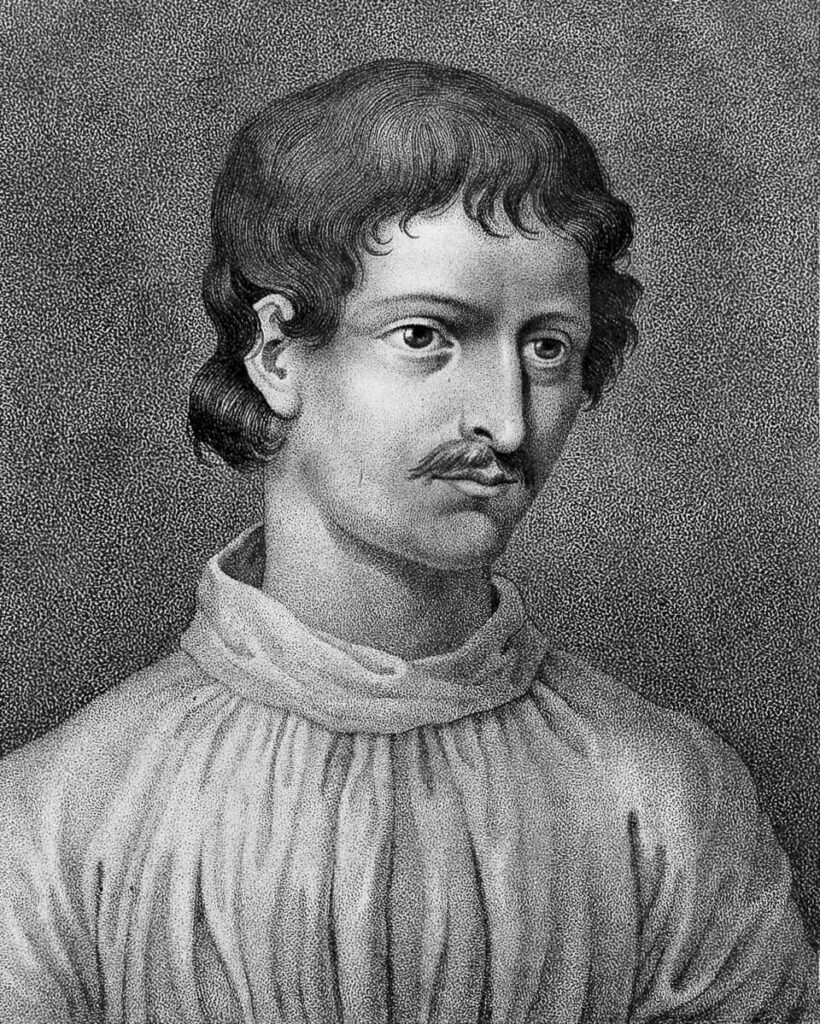

The Philosophy of Giordano Bruno
Infinity and the Life of Nature
Giordano Bruno’s philosophy begins with the conviction that reality is an infinite, living whole, and that human beings understand themselves through their participation in it. His cosmology, metaphysics, and account of knowledge develop the consequences of this conviction. Nature possesses its own formative powers; mind belongs to the fabric of the world; and philosophical understanding changes the person who pursues it. Read together, these ideas make Bruno a philosopher of human transformation as well as of cosmic infinity. [1]
Bruno developed his arguments through an unusually varied inheritance. Neoplatonism supplied ways of thinking about unity and multiplicity; ancient atomism offered alternatives to Aristotelian physics; Copernicus made a moving Earth intellectually possible. He also drew on Nicholas of Cusa and writings attributed to Hermes Trismegistus. These traditions supplied resources that Bruno freely reworked. His dialogues, poems, and technical treatises accordingly approach related problems through different vocabularies. Leo Catana’s warning against imposing a later ideal of a perfectly systematic philosophy on Bruno is useful here: coherence need not mean that every formulation fits without strain. [1, 2]
The best-known result is a universe without an outer boundary or a privileged center. Copernicus had moved the Earth while retaining a bounded cosmos. Bruno removed the enclosing sphere of stars and distributed suns and earths throughout limitless space. Our Sun became one sun among innumerable others. In On the Infinite Universe and Worlds, he also defended inhabited worlds beyond our own. Their inhabitants were a philosophical inference from nature’s fertility, rather than an astronomical discovery. The significance reaches beyond the number of planets: our location no longer establishes our importance in the order of being. [3, 4]
Bruno’s argument attacks the intelligibility of a final cosmic wall. If a boundary exists, what lies beyond it? Calling the beyond ‘nothing’ does not satisfy him, since he understands an absence of bodies as space capable of receiving bodies. Nor does he find a reason why one region should contain a world while an otherwise comparable region remains empty. This reasoning makes the apparent edge of the heavens a limitation of our perspective. Philosophically, the decisive move is to deny that the limits of what we perceive establish the limits of what exists. [3]
A further argument connects cosmic infinity to divine power. An infinite cause, Bruno reasons, should express itself through an infinite effect. He rejects the scholastic distinction between everything God could create and the limited creation God freely chooses. Divine power, willing, and activity coincide; infinite power cannot remain largely unexpressed. The universe is therefore eternal as well as spatially infinite. The controversial step is the passage from what an unlimited cause could produce to what it must produce. Bruno’s cosmology depends on this account of divine perfection, so its metaphysical commitments are essential to assessing its claims. [5]
The corresponding account of nature appears in Cause, Principle and Unity. Bruno argues that matter possesses an enduring capacity to bring forth forms. A plant’s organization emerges through nature working within it, rather than through the imposition of shape on an inert material. His distinction between cause and principle helps articulate this view: a principle belongs to the constitution of a thing, while a cause explains its production. Nature’s formative activity operates within the material world whose changing bodies it produces. [6]
The World Soul names the animating principle present throughout nature. Bruno’s universe contains life at different levels, including a vestigial animation in things ordinarily called inanimate. Celestial bodies can be understood as great living beings. This position is often described as panpsychism or universal animism, though those labels require care. A stone need not possess a person’s reflective consciousness for both to participate in a common living reality. The philosophical claim concerns continuity: mind and life do not enter nature as inexplicable intrusions into a fundamentally lifeless order. [7]
Bruno’s account of unity goes further. Matter and form, and what a thing is and can become, ultimately belong to one reality. Particular beings express its changing configurations. Their differences do not establish separate, self-sufficient foundations of existence. His use of the coincidence of opposites serves this argument: distinctions indispensable for describing finite things cannot simply be projected onto their ultimate ground. The resulting difficulty is substantial. Bruno must explain how an undivided reality supports the differentiated world we experience. His philosophy repeatedly returns to this problem rather than disposing of it once and for all. [6, 2]
This continuity also changes the meaning of death. Particular combinations dissolve, while the material and animating principles through which they exist endure. Bruno presents this understanding as a release from the fear of annihilation. He also defends transmigration of souls, extending continuity across the boundaries between human and animal life. These claims should be distinguished: the persistence of nature’s principles alone does not demonstrate that an individual’s memories and personality survive. His metaphysics offers a framework for interpreting death, while leaving questions about personal identity that require further argument. [5, 6]
His formula ‘Nature is God in things’ captures the divine presence within natural activity. Yet Bruno also preserves a divine source that exceeds human comprehension. This complicates the label pantheism. We encounter divinity through its expression in nature, without thereby comprehending the divine essence absolutely. God and the universe are infinite in different ways: the universe extends without limit while its particular worlds remain finite; divine infinity is indivisible. Bruno’s immanence therefore coexists with a distinction between the ultimate source and the differentiated reality through which we know it. [5, 4]
Bruno’s arguments about motion show how this philosophy could engage concrete physical problems. In The Ash Wednesday Supper, he answers the objection that a moving Earth would leave falling objects behind. A stone dropped from a ship’s mast shares the ship’s movement and falls toward its foot; terrestrial objects likewise participate in the Earth’s motion. The example identifies an error in treating the observer’s apparent rest as absolute rest. Bruno develops it through the inherited language of impetus. Its interest lies in explaining how ordinary experience can be compatible with a moving Earth, without treating the argument as a complete anticipation of later mechanics. [8]
His later work also investigates the minimum: the atom in physics, the point in mathematics, and the monad in metaphysics. These are attempts to understand the smallest units or principles through which reality becomes intelligible. As Paolo Rossini argues, Bruno’s changing mathematics belongs to his effort to connect physics and metaphysics within one account of nature. That ambition generated serious difficulties in his geometry. It also reveals why his thought resists a simple opposition between scientific insight and mystical speculation. Bruno sought connections among disciplines that subsequent inquiry would handle with different methods and standards of proof. [9]
His theory of knowledge gives imagination a central role. Human understanding works through images, and the organization of those images can improve its grasp of relationships. This explains the philosophical importance of his art of memory. In works such as On the Shadows of Ideas, mnemonic arrangements help the mind organize multiplicity and approach intelligible order. His diagrams give this work a concrete technique: the practitioner arranges images and explores their connections. Zheng Wang’s study emphasizes that images mediate between sensory experience and intellectual understanding. They also engage feeling and attention. Bruno treats cognition as an activity we can cultivate through practice, with consequences for how experience is ordered and understood. [10]
Desire supplies another condition of understanding. The Heroic Frenzies presents philosophical love as an aspiration toward infinite beauty and truth. Its ‘frenzy’ involves the intense cooperation of intellect and will. Since finite understanding cannot exhaust its infinite object, the pursuit continually exceeds each achieved conception. Read this way, Bruno makes intellectual incompletion compatible with fulfillment: the desire to understand can remain active without promising final possession of everything that is knowable. The aspiration itself transforms the capacities of the person who sustains it. [11]
His interpretation of Actaeon gives this transformation a striking image. The hunter sees Diana, becomes a stag, and is devoured by his own dogs. Bruno interprets the hunt as the intellect’s pursuit of divine wisdom; the dogs are the hunter’s thoughts. The seeker becomes the sought, discovering within himself the divinity he pursued outside. The philosophical point, as I read it, is that knowing nature alters the knower’s understanding of his own being. The investigator belongs to the reality he seeks to comprehend, and that recognition changes the meaning of the investigation. [11]
Bruno’s magic follows from the same concern with participation and influence. In his framework, natural bodies and minds affect one another through powers that may escape direct observation. The practitioner tries to understand those powers and prepare conditions in which they can operate. Alfonso Ingegno’s introduction to Bruno’s magical writings shows how seriously Bruno also took spirits and demonic influences. Translating all this into modern psychology would erase part of his position. His philosophical ambition was to explain operations throughout a connected living nature, including operations whose alleged reality modern readers have good reason to question. [12]
A General Account of Bonding extends this inquiry into human relationships. People can be bound through their inclinations, habits, ambitions, and circumstances. Effective influence requires understanding the person affected: what moves one individual may leave another unmoved, and the same individual changes with age and condition. Bruno explicitly connects these bonds to civil life and the coordination of a state’s members. This makes desire politically consequential. An account of how minds respond to images and attractions can explain persuasion, allegiance, and dependence as well as philosophical aspiration. [13]
There is an ethical tension here. Knowledge of influence may help someone become less vulnerable to manipulation, while also giving that person greater power over others. Ingegno identifies this difficulty in a philosophy concerned with liberation that also describes ways of establishing control. Alberto Fabris’s recent interpretation places bonds at the center of Bruno’s account of changing relations throughout nature. Whatever weight one gives that interpretation, the practical question remains: understanding the forces that shape us does not by itself determine how we should use them. [12, 14]
Bruno addresses conduct directly in The Expulsion of the Triumphant Beast. Its reform of the heavens represents an ordering of human life in which virtues replace vices. Truth and justice must become effective in institutions and actions. His praise of intellect together with hands makes productive activity central: human beings develop their powers through work, invention, and the cooperation of contemplation with action. The familiar dream of an effortless Golden Age consequently loses its authority. Human excellence requires the exercise of capacities that idleness leaves unused. [15]
His criticism of religion follows this practical emphasis. He attacks teachings that, in his judgment, encourage confidence in salvation while weakening the obligation to act well. Laws and religious institutions should be assessed through their contribution to human society. This does not make him a straightforward advocate of modern religious equality. On the Infinite Universe and Worlds distinguishes the demonstrative understanding appropriate to philosophers from the faith used to govern a wider population. His defense of philosophical inquiry stands alongside an unequal distribution of intellectual authority. These commitments complicate any easy identification of Bruno with contemporary liberalism. [15, 4]
The connection among these ideas is strongest when Bruno asks what participation in nature demands of us. An infinite universe removes the assurance that our place confers cosmic privilege. A living universe nevertheless gives our capacities a natural foundation. His accounts of imagination, philosophical love, and work describe ways those capacities can grow. My assessment is that his most productive achievement lies in connecting the structure of reality with the activity of understanding it. His weakest transitions occur where a demand for metaphysical completeness becomes a claim about what nature must contain. Reading Bruno critically means keeping both the reach of that project and the force of its arguments in view. The finite thinker can pursue an inexhaustible reality while remaining answerable for how that pursuit changes his life among other beings.
Sources and Texts
[1] Paul Richard Blum. Giordano Bruno. Internet Encyclopedia of Philosophy. Read online Scholarly overview of Bruno’s intellectual sources, metaphysics, and mnemonic work.
[2] Leo Catana. Coincidence of opposites: Cusanian and non-Cusanian interpretations in the thought of Bruno. Bruniana e Campanelliana 17 no 2 (2011), 381–400. Read online The abstract cautions against imposing later expectations of philosophical system building on Bruno.
[3] Alexandre Koyré. The New Astronomy and the New Metaphysics. Chapter 2 of From the Closed World to the Infinite Universe (1957). Read online Analysis of Bruno’s infinitism with translated extracts from his cosmological dialogues.
[4] Giordano Bruno. On the Infinite Universe and Worlds. 1584, especially dialogues 1 and 3; Italian text in Dialoghi metafisici, edited by Giovanni Gentile (1925). Read online Primary text for divine and cosmic infinity, inhabited worlds, and the distinction between philosophy and popular religion. Consulted in Italian; the essay paraphrases it.
[5] Dilwyn Knox. Giordano Bruno. Stanford Encyclopedia of Philosophy, revised March 12 2024, especially sections 6 and 7. Read online Detailed treatment of divine omnipotence, infinity, immanence, and transcendence.
[6] Giordano Bruno. Cause, Principle and Unity. 1584; translated by Robert de Lucca in Cause, Principle and Unity and Essays on Magic (Cambridge University Press, 1998), prefatory summaries of dialogues 2–5. Read online Primary text for matter’s formative powers, the unity of matter and form, and the interpretation of death.
[7] E J Ashworth. Bruno, Giordano (1548–1600). Routledge Encyclopedia of Philosophy (1998), article summary. Read online Concise account of the animate universe and the relationship between matter and the World Soul.
[8] Giordano Bruno. The Ash Wednesday Supper. 1584, dialogue 3; translated by Stanley L Jaki (1975), extract hosted by Dartmouth College. Read online Primary text for the ship example and the shared motion of terrestrial bodies.
[9] Paolo Rossini. Changing conceptions of mathematics and infinity in Giordano Bruno’s vernacular and Latin works. Science in Context, published online June 7 2021. Read online Study of Bruno’s evolving mathematics and the physical, metaphysical, and mathematical minimum.
[10] Zheng Wang. The role of iconic practice in Bruno’s gnoseology. Humanities and Social Sciences Communications 9, article 211 (2022). Read online Study of imagination, images, and philosophical uses of the art of memory.
[11] Giordano Bruno. The Heroic Frenzies. 1585; consulted in The Heroic Enthusiasts, translated by L Williams (1887), part 1, dialogues 3–5. Read online Primary text for the pursuit of infinity and the allegory of Actaeon. The translation is older; Ingrid D Rowland’s On the Heroic Frenzies (University of Toronto Press, 2013) is a modern edition.
[12] Alfonso Ingegno. Introduction. In Giordano Bruno, Cause, Principle and Unity and Essays on Magic (Cambridge University Press, 1998), especially pages xxiii–xxvii. Read online Study of natural magic, demonic influence, agency, and the ethical problem of controlling others.
[13] Giordano Bruno. A General Account of Bonding. De vinculis in genere, composed about 1590; translated by Richard J Blackwell in Cause, Principle and Unity and Essays on Magic (Cambridge University Press, 1998), 143–176; opening passage. Read online Primary text linking individual dispositions, effective influence, and civil life.
[14] Alberto Fabris. Ontology of Bonds: Sympathy, Desire and Matter in Giordano Bruno. Journal of Interdisciplinary History of Ideas 14 no 28 (2025), abstract. Read online Recent interpretation of binding as a principle of changing relations across nature, psychology, and politics.
[15] Giordano Bruno. The Expulsion of the Triumphant Beast. 1584; translated by Arthur D Imerti (1964), especially dialogues 1 and 2. Read online Primary text for moral reform, justice, work, the conjunction of intellect and hands, and criticism of religious reliance on faith without works.